A recent technical presentation highlighted why the internal design of flexible endoscopes remains one of the biggest challenges for effective cleaning, disinfection and infection prevention.
Flexible endoscopes have transformed clinical practice, but their intricate internal channel systems create a persistent challenge for decontamination teams. In a presentation titled Where the Flow Meets the Pressure, Ronald Wassenburg explored how channel complexity, variable diameters, interconnected pathways and non-standardised connectors can make it difficult to prove that every internal surface has been reached by cleaning and disinfecting fluids.
The message was clear: while endoscope imaging technology has advanced dramatically over the past three decades, the underlying channel architecture has changed far less. For those responsible for safe reprocessing, that matters.
Why channel design matters
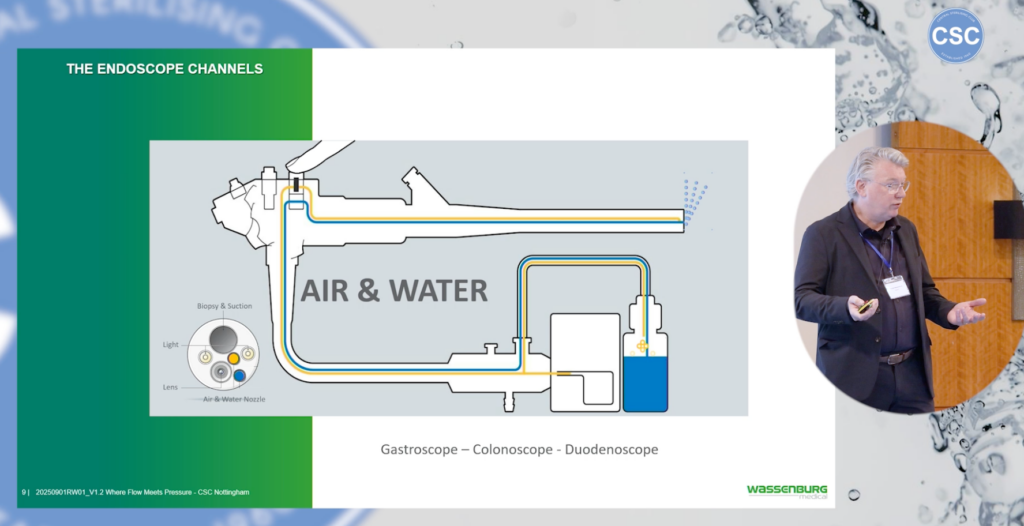
An endoscope may appear straightforward from the outside, but internally it contains multiple channels serving different functions. Air and water channels clean and dry the lens; biopsy and suction channels remove material; colonoscopes may include water-jet channels; and more complex devices such as duodenoscopes and ultrasound endoscopes can include elevators, balloons and additional channel systems.
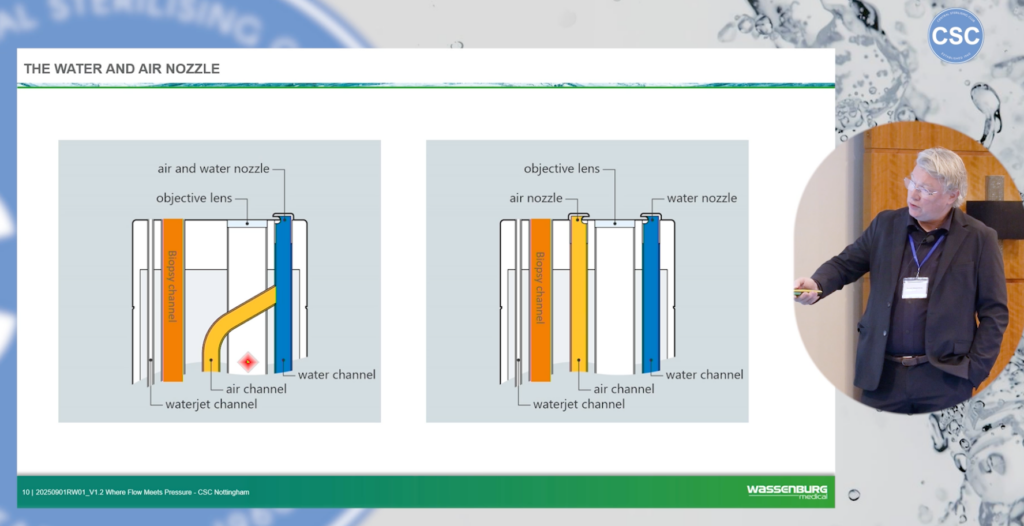
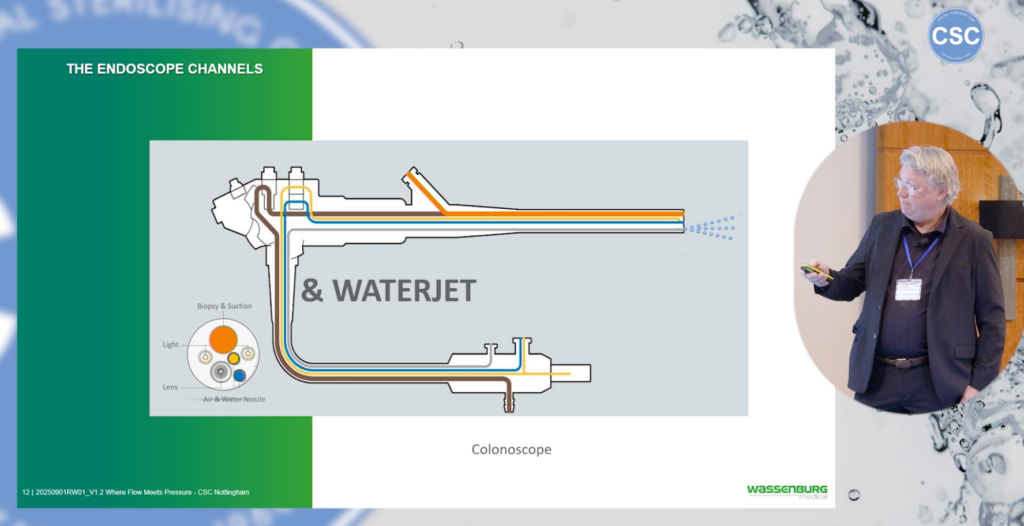
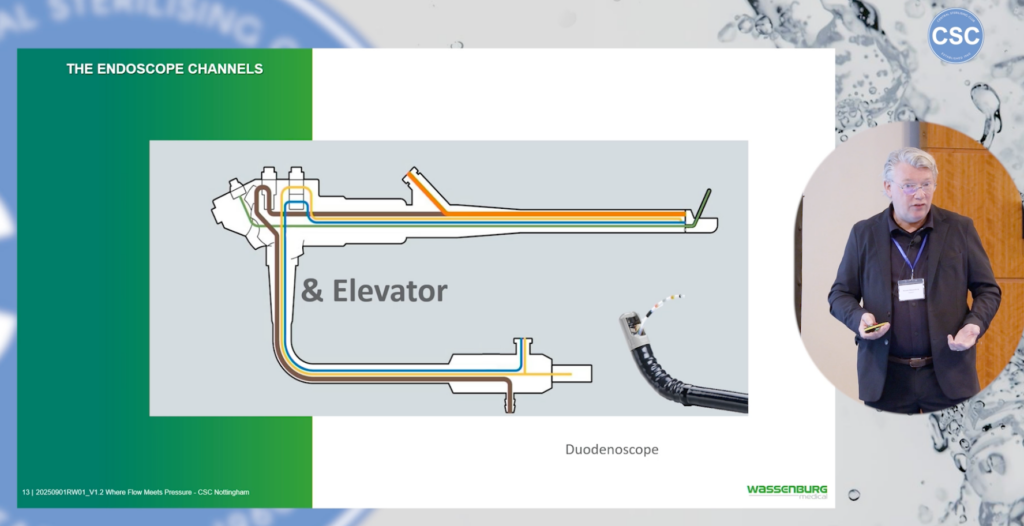
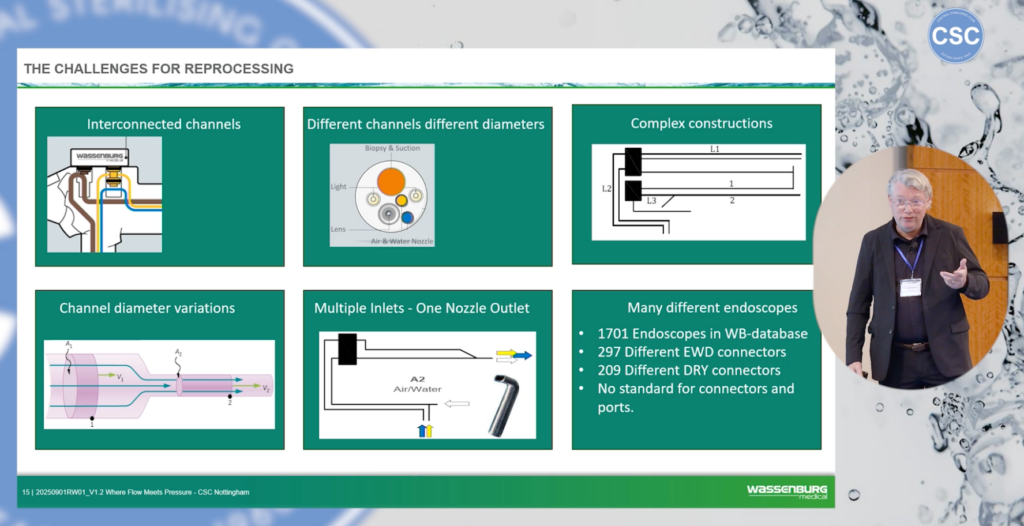
These channels often vary in diameter, join or separate at different points, and may have several inlets but only one outlet. This makes reprocessing more than a simple flushing exercise: teams must understand exactly where fluid is travelling, whether all areas are contacted, and whether a blockage or partial restriction could go unnoticed.
The challenge of proving contact
The fundamental aim of reprocessing is to bring cleaning and disinfecting fluids into contact with every internal and external surface of the endoscope. That includes all channels, cavities and hard-to-reach areas. Once that contact is achieved, the process must be monitored consistently and supported by traceability to demonstrate that the correct conditions were met every time.
However, complex construction can make this difficult. If two channels meet before the distal tip, fluid may follow the path of least resistance. A partial blockage may only become measurable when the narrowing is smaller than the nozzle opening. As a result, understanding the physical design of each endoscope is essential when interpreting flow, pressure and blockage detection.
Duodenoscopes remain a particular concern
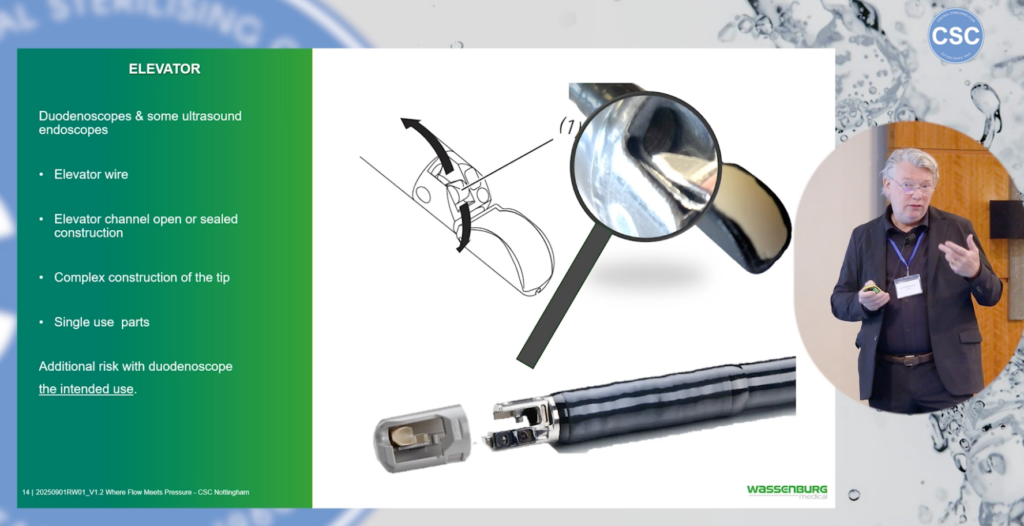
Duodenoscopes were identified as especially challenging because their optics look sideways rather than forwards. To guide instruments into the correct position, they use an elevator mechanism at the distal end. This construction introduces additional surfaces, moving parts and potential retention points for contamination.
Older open elevator-wire systems can be particularly problematic because movement of the wire may draw soil further into the channel. If contamination dries, it can contribute to obstruction and increase the difficulty of cleaning. Newer closed systems and single-use caps reduce some of this risk, but they do not remove the need for careful manual preparation before automated reprocessing.
Standards help, but standardisation is still limited
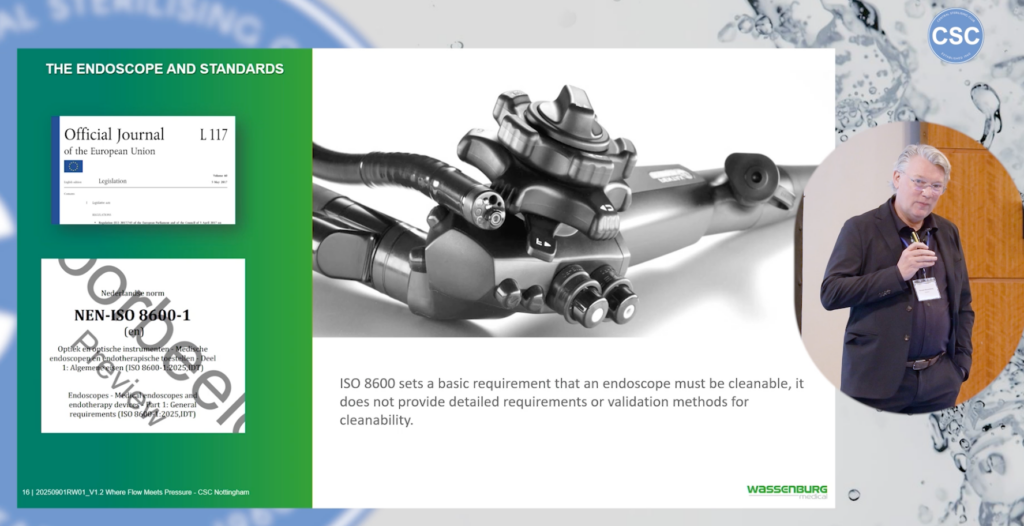
The presentation also drew attention to the limited standardisation across endoscope designs and connectors. A database referenced during the talk contained around 1,700 endoscopes with different constructions and nearly 300 connector types for washer-disinfectors, illustrating the scale of variation that manufacturers, hospitals and reprocessing teams must manage.
methods, including approaches that allow evidence to be grouped across similar endoscope configurations. This can make validation more manageable, but it does not remove the need to understand the specific combination of endoscope design, connector, channel layout and washer-disinfector performance.
Pressure, flow and the “worst case” question
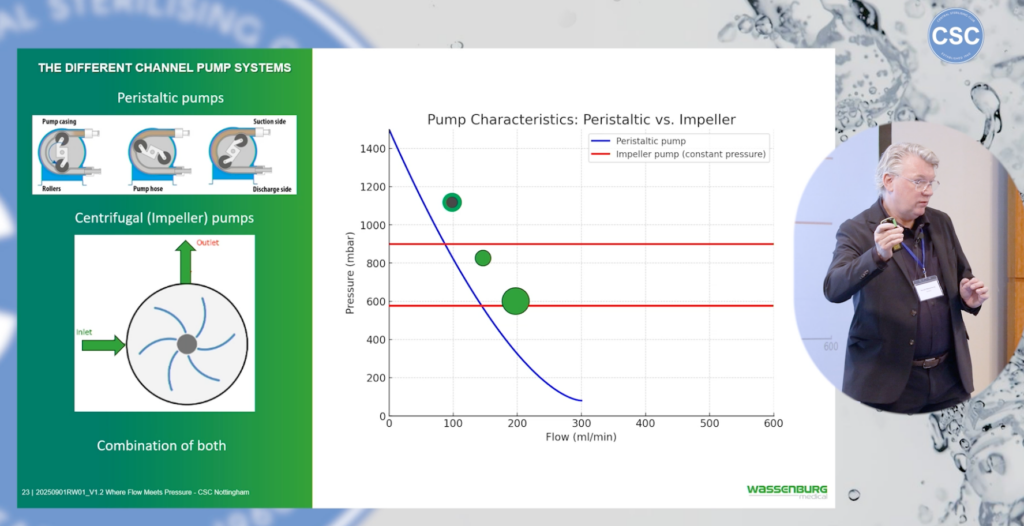
One recurring question is how to identify the “worst case” endoscope for testing. The answer depends not only on the endoscope but also on the washer-disinfector’s pumping system. A peristaltic pump may generate higher pressure with lower volume, making it more suited to small, high-resistance channels. An impeller pump may deliver higher volume at lower pressure, which may suit larger channels such as biopsy channels.
For manufacturers, this makes type testing and design verification complex. For hospitals, it reinforces the need to validate that their own endoscopes can be processed safely within their own local systems and workflows.
Manual cleaning remains critical
The question-and-answer session returned repeatedly to the role of manual cleaning. The speaker emphasised that awareness is the starting point, especially for high-risk devices such as duodenoscopes. Staff must understand which scopes are more complex, why prompt pre-cleaning matters, and how easily contamination can dry within difficult areas. Reusable valves and buttons remain another area of debate, particularly as sustainability pressures encourage organisations to reconsider single-use items. While some progress may be possible, the wide variety of valve designs means that universal automated processing remains difficult. For now, careful pre-cleaning or single-use components remain important risk controls, depending on local policy and manufacturer instructions.
Key takeaways for reprocessing teams
- Understand the construction of every endoscope type in use, including channels, valves, connectors and distal-end mechanisms.
- Recognise that flow and pressure measurements depend on both endoscope design and washer-disinfector performance.
- Pay particular attention to duodenoscopes, ultrasound endoscopes and devices with elevators, balloons or interconnected channels.
- Prevent soil from drying by moving scopes promptly from the procedure area to pre-cleaning.
- Follow manufacturer instructions for use and ensure staff are trained in the specific risks of complex channel systems.
- Use monitoring, validation and traceability to demonstrate that reprocessing is consistent and effective.
A call for better design

The presentation ended with a challenge to endoscope manufacturers: future innovation should focus not only on imaging capability but also on internal design. Simpler, more separable, more cleanable channel systems would support safer reprocessing and reduce reliance on complex manual steps.
Radical redesign may not be easy, but the goal is clear. If endoscopes are to become safer and easier to reprocess, cleanability must be treated as a core design priority rather than an afterthought.