A summary of Lee Clark’s session on innovation, validation and collaboration in robotic instrument reprocessing.
As robotic-assisted surgery becomes a familiar part of hospital life, sterile services departments are being asked to support increasingly complex instrumentation without compromising patient safety, turnaround times or departmental workflow. In a recent session, Lee Clark of Intuitive explored how the reprocessing of robotic instruments has evolved, and how a seemingly simple innovation—a dedicated tray or basket approach—could help departments manage growing demand more efficiently.
From specialist technology to everyday equipment
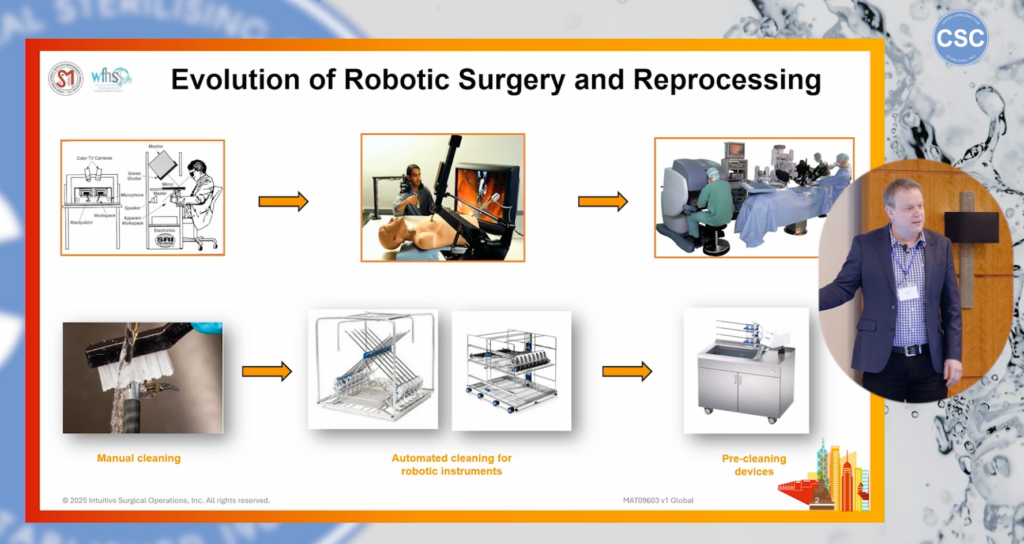
Lee opened by reflecting on the journey of the Da Vinci robotic system, which began more than 30 years ago as an engineering ambition and has since moved steadily into mainstream surgical practice. Audience participation quickly confirmed the point: surgical robots are no longer unusual in many hospitals, and the sector is moving from seeing robotics as “special” to viewing them as part of normal clinical infrastructure.
That normalisation brings a practical challenge. Robotic instruments are intricate, delicate and different from traditional surgical equipment. For sterile services teams, this has meant adapting cleaning, disinfection and sterilisation processes to ensure instruments are safe, reliable and ready for use.
Improving cleaning without lowering the safety bar
Throughout the session, patient safety remained the central theme. Lee emphasised that any process improvement must maintain or improve the safety of instruments, never reduce it. Over time, advances in manufacturing, materials and validated automated processes have already improved reliability and helped sterile services teams achieve more consistent outcomes.
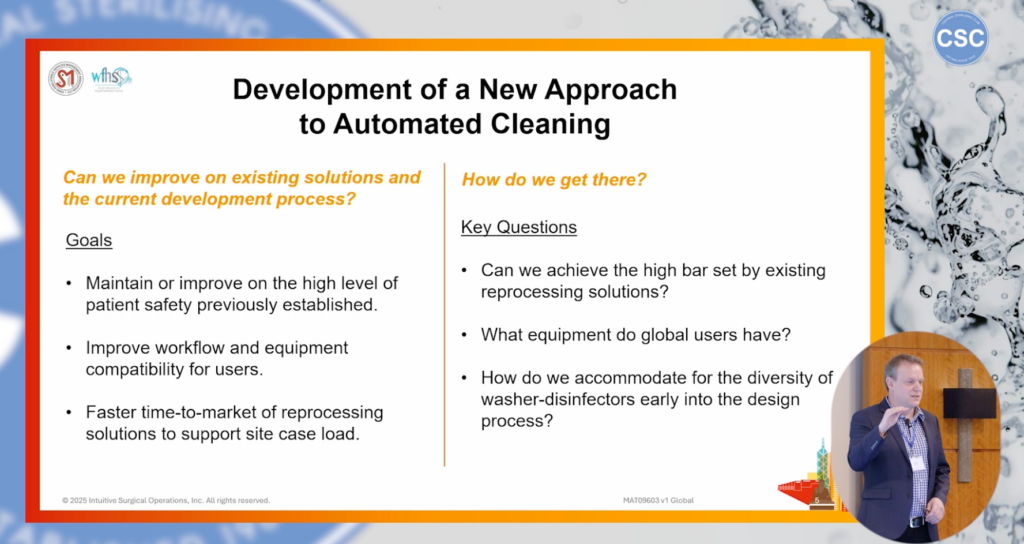
Pre-cleaning and automation are now becoming particular areas of focus. Dedicated solutions for robotic instruments are emerging, and Lee encouraged continued collaboration with companies developing technologies that may support safer processing and better departmental workflow.
The hidden challenge: development takes time
The “new and revolutionary idea”, Lee noted with humour, is a tray—or, in his terminology, a basket. The approach is designed to support robotic instruments through washing and sterilisation while connecting to standard washer-disinfector infrastructure using familiar filtered manifolds and luer-lock style connections.
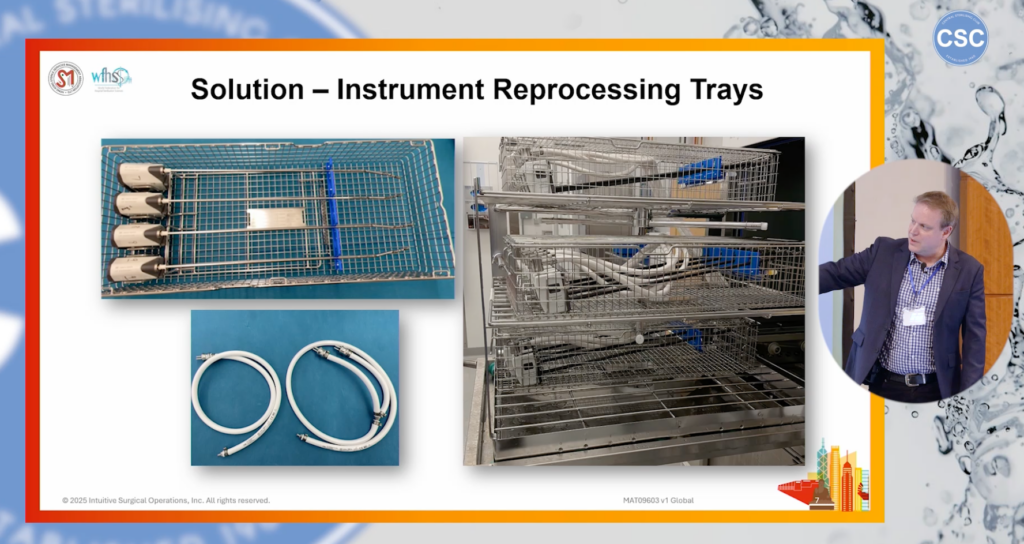
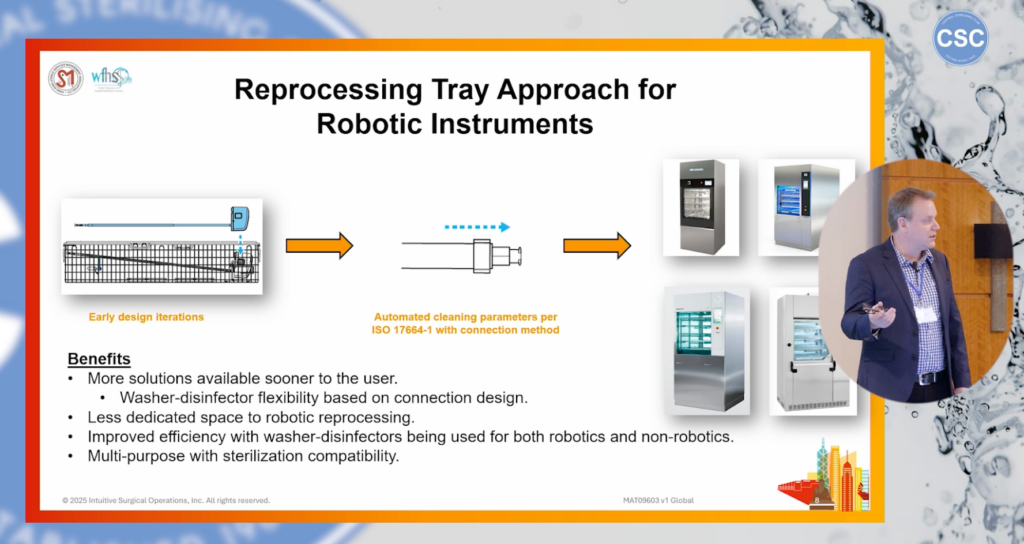
Rather than requiring a dedicated wash rack for every new device, the basket provides a blueprint for engineers and a more flexible platform for sterile services. If the basket and connectors fit within the washer-disinfector and the required parameters are achieved, departments can move towards validated cleaning without waiting for a bespoke rack solution.
Benefits for sterile services departments
- Faster access to solutions: Sites may avoid long lead times associated with ordering dedicated wash racks.
- Greater flexibility: Existing washer-disinfector infrastructure can potentially be used, provided compatibility and validation requirements are met.
- Better use of space: Departments can avoid storing large dedicated racks that are only used occasionally.
- Improved loading efficiency: A basket occupying one shelf may leave room for other items, supporting better use of washer capacity.
- Reduced handling: Instruments can remain in the basket for washing and sterilisation, helping minimise handling across the process.
Validation remains essential
Lee was clear that innovation does not remove the need for rigorous validation. Instruments undergo simulated surgical use, including exposure to soil and movement that reflects clinical use. They then proceed through manual pre-cleaning and automated washer-disinfector cycles before protein detection testing is performed.
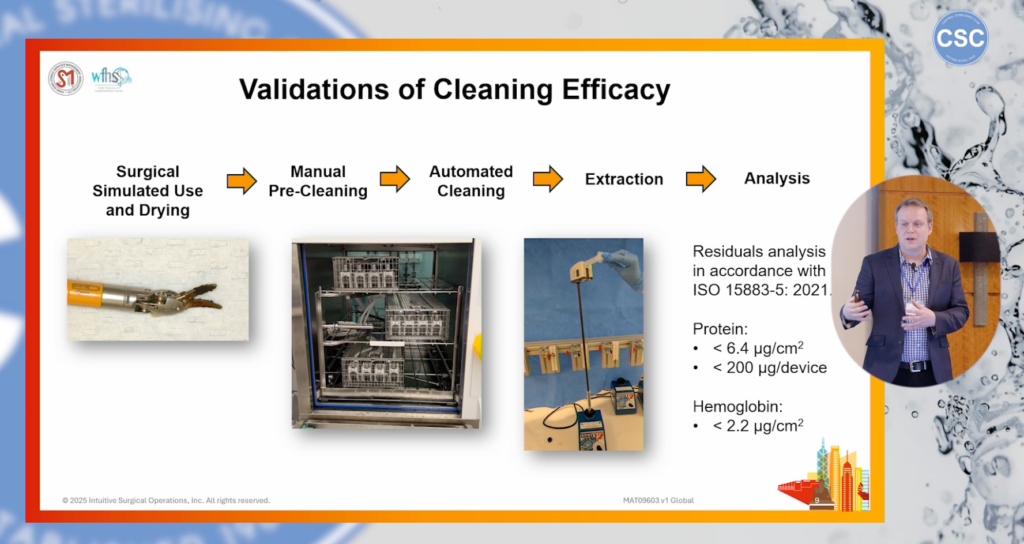
While published instructions refer to EN ISO 15883 requirements, Lee acknowledged that many local guidance documents set lower expectations. Intuitive’s internal limits, he said, are lower than the broad 200 microgram benchmark discussed during the presentation. Sterilisation validation is also performed, with biological indicators placed in the most challenging locations for steam penetration.
Case examples: faster implementation and less clutter
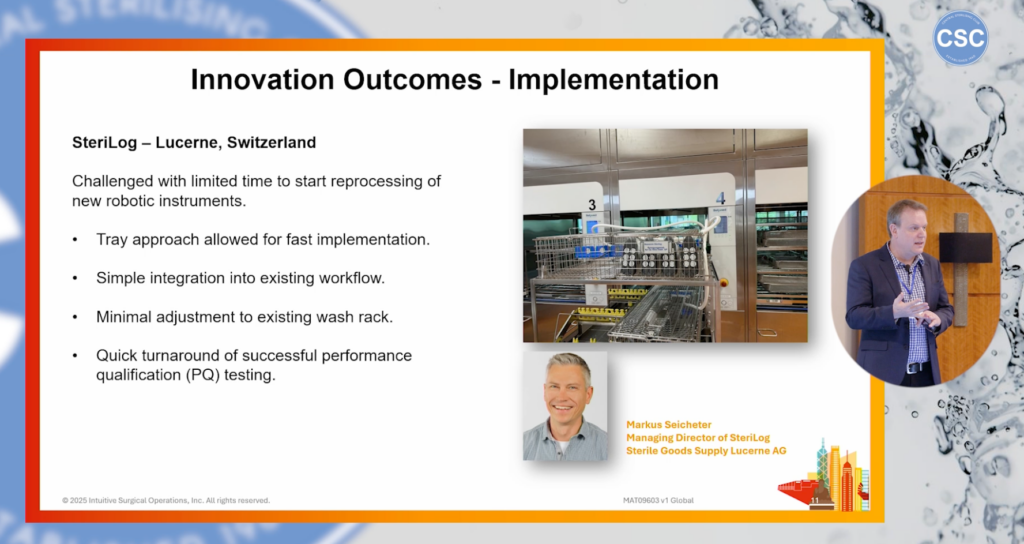
Two practical examples illustrated the potential impact. At one site introducing a Da Vinci SP system, the basket approach avoided the need to wait for a dedicated wash rack, saving an estimated eight to ten weeks. Existing wash rack infrastructure and suitable manifold connections allowed performance qualification to be completed and the service to begin sooner.
Another London site, operating within a particularly small sterile services department, benefited from avoiding a dedicated robotic wash rack taking up valuable space. Staff also valued the reduced need to remove and reload instruments between washing and sterilisation.
Questions from the floor
The discussion that followed highlighted several practical concerns for departments. On detergents, Lee explained that washer manufacturers validate a complete process made up of the washer, rack, detergent and cycle. If a hospital chooses a different detergent, responsibility for proving cleaning efficacy may shift to the hospital. Material compatibility remains important, with detergent requirements referenced in the instructions for use.

Protein testing also prompted discussion. Lee cited data from a German laboratory showing an average of 34 micrograms of protein across more than 4,000 data points, while acknowledging that averages can hide outliers. He shared an example where unusually high results were later linked to false positives caused by lubrication oil applied to sterile instruments before testing. The takeaway was clear: testing is important, but so are staff training, correct sampling and careful interpretation.
When asked about the future impact of robotic surgery on decontamination, Lee suggested that automation within sterile services—and potentially artificial intelligence—will play an increasing role in helping departments keep pace with demand.
Collaboration is the way forward
The session closed with a strong message: safe robotic surgery depends on more than the robot itself. Manufacturers, washer-disinfector companies, sterile services teams, hospitals and technology providers all have a role to play. As Lee put it, surgery cannot happen if instruments are not clean.
As robotic-assisted surgery continues to grow, the challenge for sterile services will be to combine safety, efficiency and adaptability. The basket approach is one example of how practical innovation, supported by validation and collaboration, can help departments meet that challenge.