A new Welsh approach to small orthopaedic implants places patient safety, regulatory accountability and organisational transparency at the centre of decision-making.
After several years of discussion, evidence review and debate, NHS Wales has reached a significant milestone in its approach to small orthopaedic implants such as screws and plates. The central question is simple but important: when unused implants are repeatedly reprocessed through sterile services, are organisations accepting risk in the right way?
The presentation explored the scientific, clinical, regulatory and legal issues behind that question, and set out how Wales has moved towards a more formal, transparent and governed position. The outcome is not a blanket mandate, but a strong recommendation to migrate towards pre-packed, sterile, single-use small orthopaedic implants wherever practicable.
The problem with repeated reprocessing
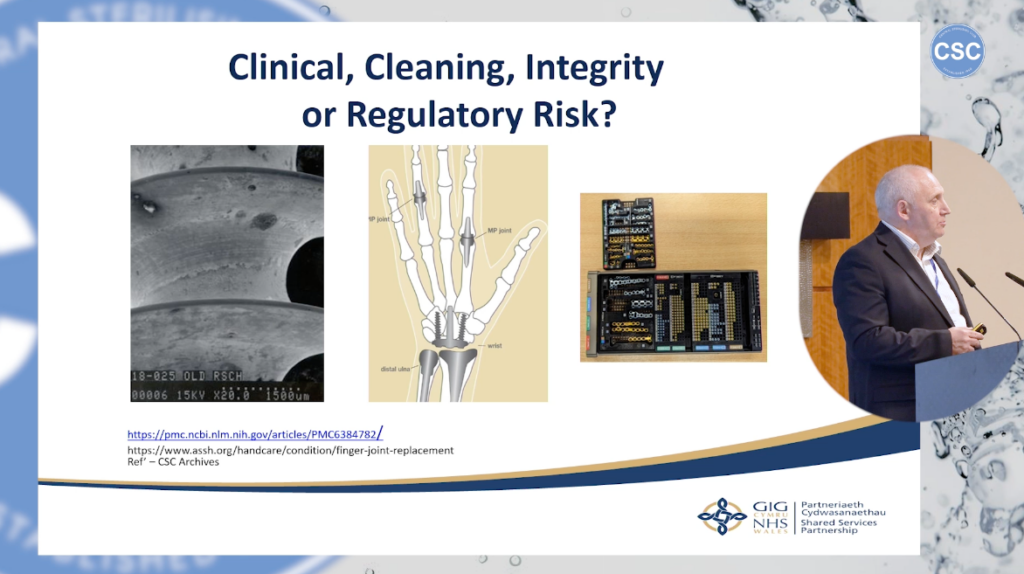
Small implants may be prepared for surgery but not used. In many settings, those unused implants have historically returned to the sterile services department and gone through the decontamination cycle again and again. Over time, this raises concerns about cleaning effectiveness, contamination status, traceability, surface damage and device integrity.
The presentation highlighted the practical challenge: small screws and plates may sit in caddies or trays, where cleaning exposure can be difficult to assure. Repeated washer-disinfector cycles can also move or dislodge small items, while visual inspection alone may not identify microscopic damage, residues or degradation.
These concerns are not only technical. They also create regulatory and governance questions. If a device is reprocessed outside the manufacturer’s intended use or instructions, the organisation may take on responsibilities and liabilities that were previously held by the manufacturer.
Learning from Scotland and the Welsh evidence base
NHS Scotland moved to a policy of using pre-packed, pre-sterilised, single-use small orthopaedic implants in the late 2000s. That decision provided an important reference point for Wales, where the structures and governance arrangements are often considered comparable.
In Wales, the Surgical Materials Testing Laboratory produced briefing work on sterile single-use plates and screws, first published in 2010 and updated in 2023. The updated briefing identified concerns around repeated reprocessing, traceability, contamination and regulatory compliance, while also recognising logistical issues such as compatibility, cost, storage, training and supply.
The Welsh discussion also drew on clinical perspectives, including concerns from hand surgeons about potential impacts on theatre efficiency, tourniquet time, patient outcomes, cost and environmental sustainability. The resulting approach therefore had to balance patient safety and regulatory compliance with practical realities in theatres and procurement.
A collaborative Welsh response
The issue was escalated through the All Wales Decontamination and Sterilisation Group after concerns were raised by sterile services colleagues who felt exposed by the risks associated with reprocessing. Their concern was clear: if sterile services staff are named on the traceability record, they should not be left carrying an organisational risk alone.
A working group was formed, bringing together NHS Wales Shared Services Partnership, the Surgical Materials Testing Laboratory, health board representatives, clinicians, Welsh Government links, the Welsh Risk Pool and other stakeholders. The group examined regulatory restrictions, legal liabilities, implant quality, traceability, contamination risks and the practicalities of moving towards single-use implants. That process was not easy. The presentation described 18 months of debate, challenge and compromise. However, the strength of the final position lies in the fact that it was shaped by multiple viewpoints rather than imposed by one professional group.
The February 2026 position
The Welsh Government letter issued on 4 February 2026 sets out a strong recommendation to migrate towards pre-packed, sterile, single-use small orthopaedic implants. It recognises that some unused implants are currently reprocessed multiple times and acknowledges the legal and regulatory risks that can arise from that practice.
Crucially, the approach does not leave risk acceptance at departmental level. Where an organisation chooses to continue using reusable or reprocessed implants, the associated risk assessment must be transparent, justified, supported by relevant expertise and signed off at executive board level.
This is a shift in emphasis. The decision is no longer framed as a local operational workaround or a matter for one sterile services manager, theatre team or surgeon. It becomes an organisational decision, with the health board recognising and owning the risk.
Risks to consider
The presentation set out risks on both sides of the decision. For single-use implants, organisations must consider storage capacity, additional cost, theatre workflow, potential delays and supply chain resilience. If single-use stock is not readily available when needed, patient care could be affected.
For reusable or reprocessed implants, the risks include regulatory non-compliance, limited traceability, work outside accreditation scope, implant degradation, cleaning uncertainty and clinical risk. The presentation also raised an ethical question: for scheduled procedures, should patients be informed if implants are being used in a way that diverges from manufacturer or regulatory expectations?
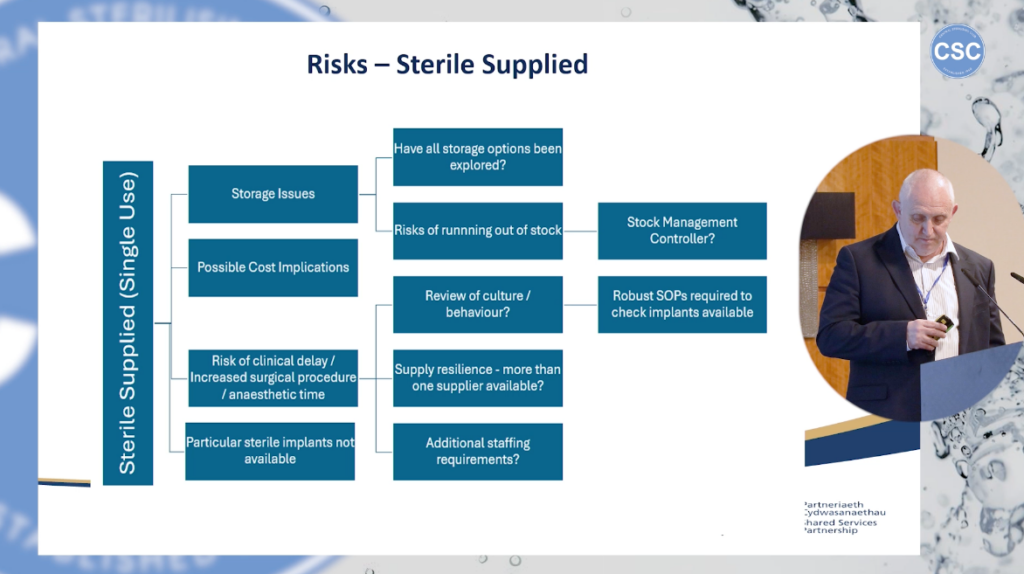
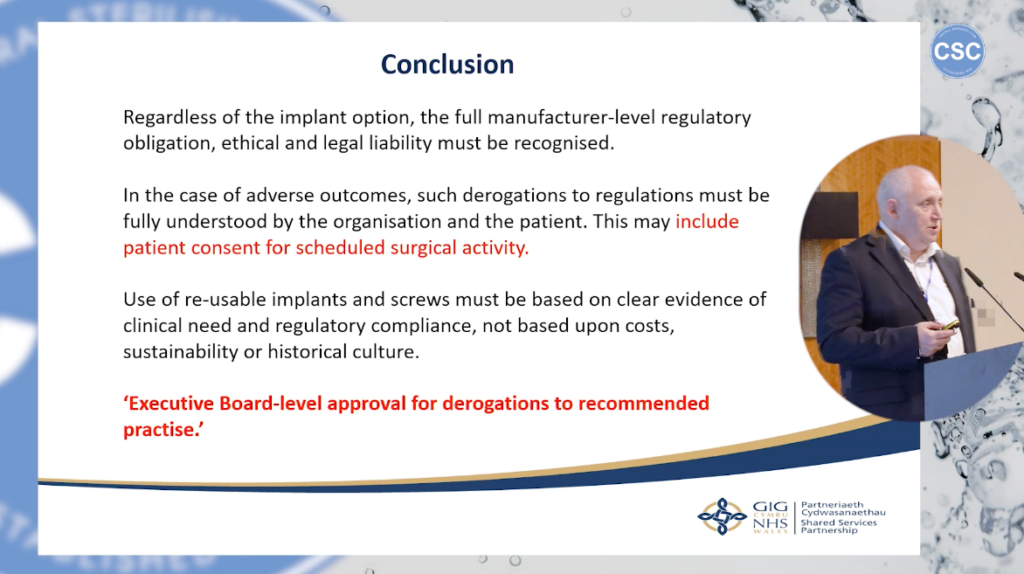
The answer proposed was not to ignore risk, but to make it visible. Any decision to depart from the recommended direction should be based on evidence, clinical need and regulatory understanding—not simply cost, convenience, historic practice or assumptions about sustainability.
Key messages for health boards
- Wales strongly recommends migration towards pre-packed, sterile, single-use small orthopaedic implants.
- Repeated reprocessing of unused implants raises concerns about cleaning, contamination, traceability, degradation and regulatory liability.
- Clinical practicality, supply chain reliability, cost, storage and sustainability must still be considered.
- Risk acceptance must be informed, deliberate, transparent and agreed by the right stakeholders.
- Where reusable or reprocessed implants continue to be used, executive board-level approval and clear governance are essential.