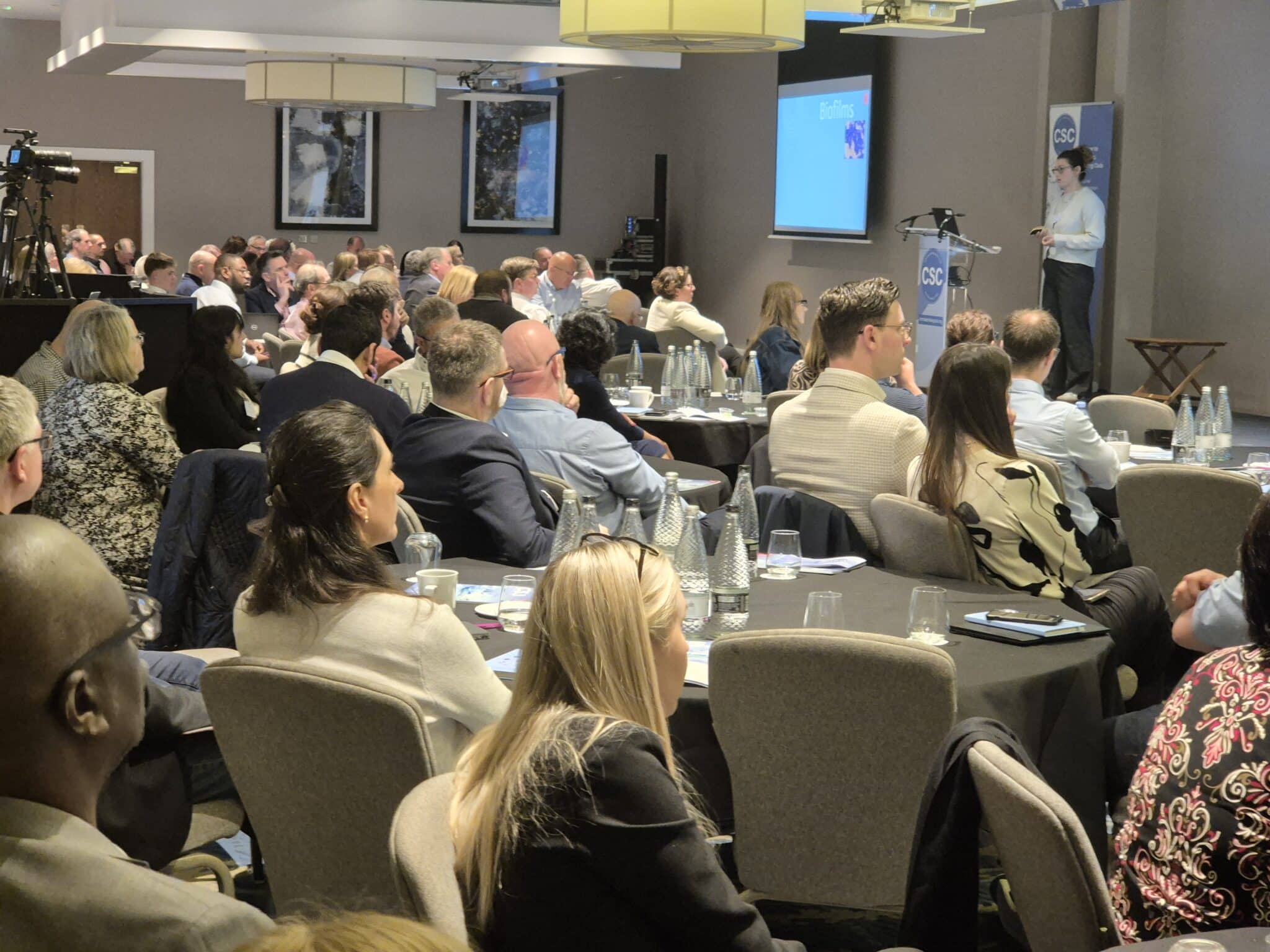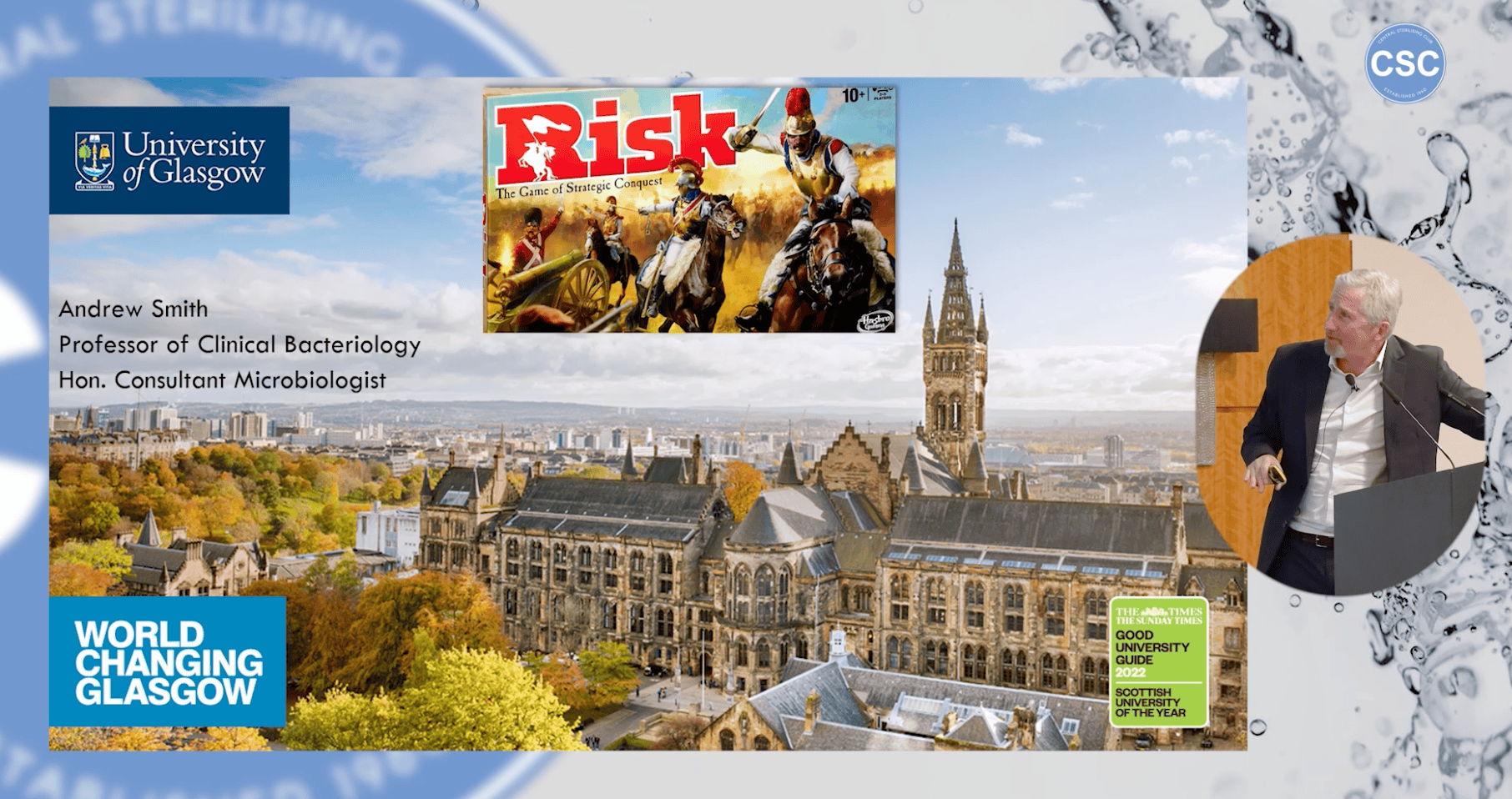
The lecture asked a central question for decontamination services: how can complex risk be explained clearly enough to support safe, confident decision-making? Across examples from sterilisation science, public health and organisational learning, Andrew showed that risk communication works best when numbers, uncertainty and confidence are made explicit.
This year’s Kelsey Lecture was delivered by Andrew Smith, Professor of Clinical Bacteriology and Honorary Consultant Microbiologist for NHS Greater Glasgow and Clyde. As lead Microbiologist for Medical Device Decontamination in NHS GGC, Andrew brought together microbiology, infection prevention and decontamination practice to explore how professionals can communicate risk more clearly.
His lecture, “Risk: The Game of Strategic Conquest,” explored how risk is understood, described and communicated in Decontamination Sciences. Drawing on J. C. Kelsey’s 1972 publication The Myth of Surgical Sterility, Andrew challenged delegates to think about how probability and uncertainty shape decision-making, and why clearer communication is essential when engaging with clinical teams, senior leaders and boards.

A key influence on Andrew’s thinking has been Professor Sir David Spiegelhalter’s work on uncertainty, particularly The Art of Uncertainty: https://www.amazon.co.uk/Art-Uncertainty-Navigate-Chance-Ignorance/dp/0241658624ow to Navigate Chance, Ignorance, Risk and Luck. The lecture used these ideas to explore how professionals can communicate evidence, confidence and uncertainty more effectively.
Andrew illustrated the consequences of unclear language using the 1961 Bay of Pigs invasion. Although the Joint Chiefs of Staff assessed the operation as having a 70% chance of failure, this was presented to President Kennedy as “a fair chance of success”. The example highlighted how words can soften, distort or obscure meaning, particularly when numbers and confidence levels are not made explicit.
Andrew reminded the audience that risk is built from two essential components:
- The probability of harm occurring
- The consequences of that harm (its severity)
In Decontamination Sciences, the harm being considered is the transmission of infection following a failure to adequately decontaminate a medical device.
The lecture then explored some of the key concepts that sit behind effective risk communication:
- Uncertainty: the conscious awareness of what we do not know, whether about the past, present, or future. In scientific terms, it can be expressed as a quantifiable estimate of error within data.
- Risk (in science): uncertainty that can be quantified in relation to a hazard.
- Probability: a measure of how likely an event is to occur, often described simply as how often something happens out of a given number of opportunities.
Andrew also introduced two common ways of thinking about probability:
- Frequentist – based on observed frequencies (e.g. a coin toss having a 50% chance of landing heads)
- Subjectivist (Bayesian) – based on informed judgement, where uncertainty resides in our knowledge rather than the environment
Both approaches assign a probability value between 0 (impossible) and 1 (certain).
The audience was invited to consider what terms such as “high risk” and “low risk” really mean in practice. Using the Spaulding classification as an example, live polling showed that interpretations varied widely, with many delegates associating “high risk” with a likelihood of 80–90%. This demonstrated the challenge of relying on terminology alone when describing infection risk.
Andrew went on to discuss surgical site infections and the factors that contribute to them, using a slide to show how risk is influenced by a range of clinical and procedural factors.

‘Clean surgery’ includes neurosurgical interventions, and the percentages shown are based on typical adult healthcare settings.
From this point, the lecture moved from the language of risk to the numbers behind it, showing how probability can help make abstract concepts more concrete for clinical and decontamination audiences.
The lecture also considered what sterility means in measurable terms. Under EN 556, a terminally sterilised medical device can be described as sterile when the theoretical probability of a viable micro-organism being present on or in the device is no greater than 1 × 10⁻⁶, following a validated sterilisation process.
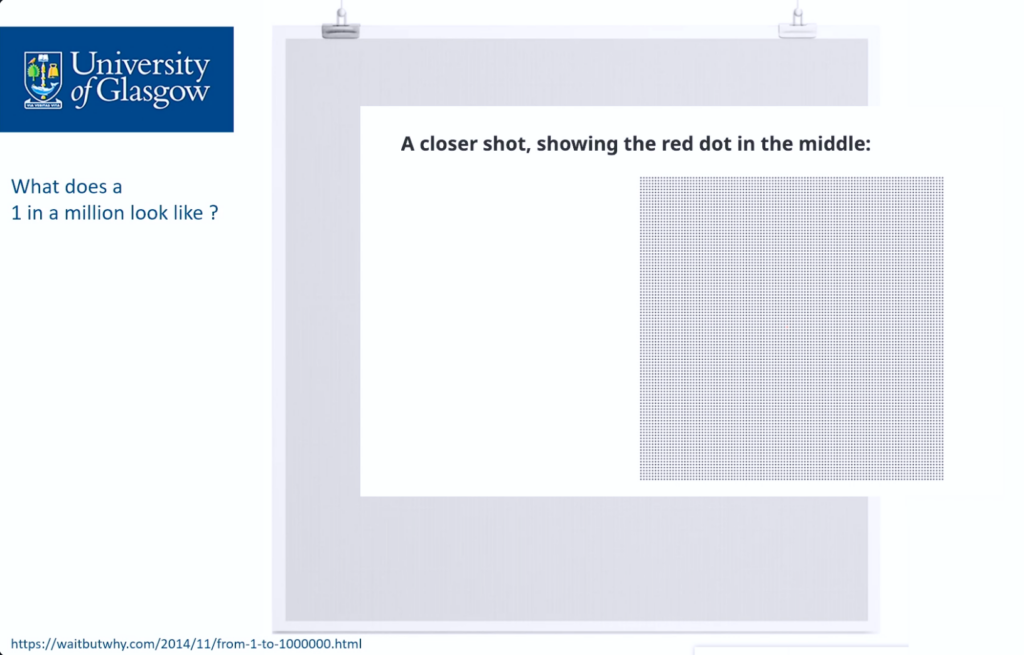
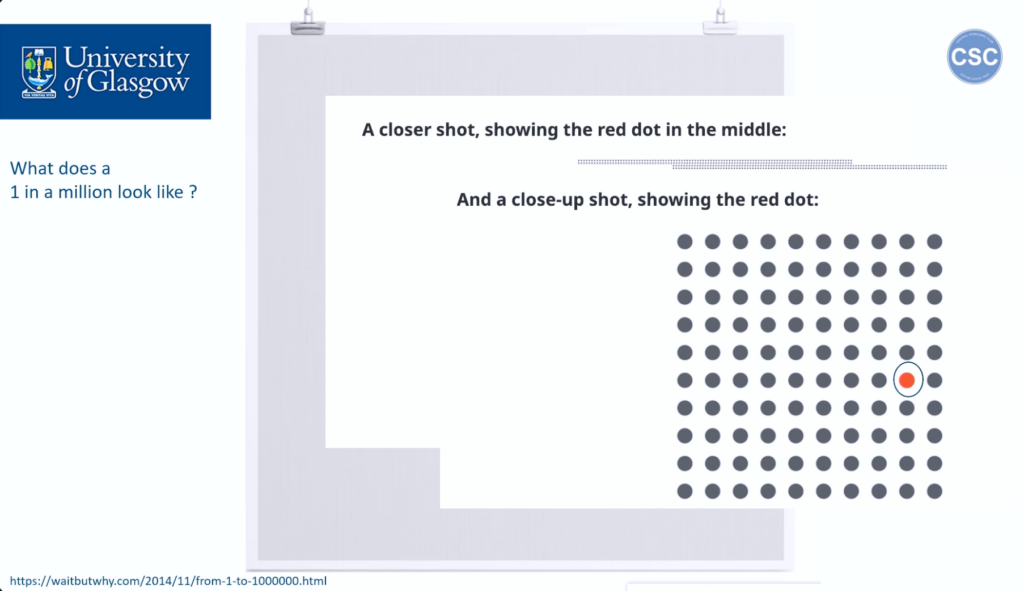
Put simply, this equates to a probability of less than one in a million that a finished device contains a viable micro-organism.
A visual of this 1 in a million chance looks like this:

Andrew then explored whether a probability can be assigned to the risk of infection when a CSSD-validated decontamination cycle and steam sterilisation are used.
Starting with the standard sterility assurance level of 1 in 1,000,000, Andrew explained that the organisms most commonly associated with surgical site infections are generally more susceptible to destruction than the heat-resistant endospores used to validate sterilisation processes. This creates an additional safety margin of 1–2 log, improving the probability to between 1 in 10,000,000 and 1 in 100,000,000.
Validated cleaning further reduces bioburden before sterilisation, adding another 2–3 log safety margin. In practical terms, this improves the estimated probability to between 1 in 100,000,000 and 1 in 10 billion.

Delegates were then asked to sense-check these assumptions through another interactive question, reinforcing the importance of shared understanding when interpreting risk figures.
The lecture returned to the importance of language by asking the audience how they understood the word “common”. Responses varied considerably, showing how even familiar words can mean very different things to different people.
Andrew compared this with regulatory definitions, highlighting the potential gap between professional terminology and patient interpretation. The message was clear: risk needs to be communicated using transparent language, clear numbers and an appropriate statement of confidence.


Andrew also outlined how the Health and Safety Executive categorises risk:
- Highest risk (unacceptable): greater than 1 in 1,000 to 1 in 10,000
- Intermediate risk (risk reduction – ALARP): 1 in 10,000 to 1 in 1,000,000
- Lowest risk (broadly acceptable): less than 1 in 1,000,000
He then described how the UK Intelligence Assessment Agency uses structured frameworks to communicate likelihood and confidence. These scales provide a consistent way to express probability, ranging from “remote chance” to “almost certain”.

A second element of this approach is the use of Analytical Confidence Ratings, which consider three factors:
- Information base
- Analytical rigour
- Complexity and likelihood of change
These factors are then summarised as high, intermediate or low confidence.
- High confidence
- Intermediate confidence
- Low confidence
Andrew demonstrated how this type of framework can support clearer communication using an example from the recent meningococcal outbreak in Kent.

The lecture also considered how surgeons assess infection risk. Across several studies, common themes included:
- A wide variation in perceived probability, ranging from 4% to 100%
- Risk perception influencing behaviour (49–85%)
- Infection risk frequently underestimated
- A tendency to rely on heuristics (intuition) rather than data
Andrew then turned to the consequences of poor risk communication and organisational decision-making. He shared examples from the Clostridioides difficile outbreak at Maidstone and Tunbridge Wells NHS Trust (2004–2006), and the waterborne and airborne infection incidents at the Queen Elizabeth University Hospital in Glasgow.
In the Maidstone and Tunbridge Wells case, more than 1,000 cases and 90 deaths were attributed to the outbreak. The investigation identified several issues:
- Infection risk was perceived as low and manageable
- Environmental contamination was underestimated
- The probability of cross-infection was not recognised
These issues were compounded by bed occupancy pressures, outsourced cleaning arrangements with unclear accountability, limited prioritisation of infection control advice and the normalisation of established ways of working.
The Queen Elizabeth University Hospital example further demonstrated how environmental risks can be underestimated. Infections in a paediatric oncology unit were linked to contaminated water outlets, with several deaths under investigation.
- Water contamination was considered very unlikely
- Environmental reservoirs were not fully recognised
- Transmission probability was not quantified
Contributing factors included fragmented governance, strained relationships between estates and infection control teams, unclear ownership of risk, delayed responses to warning signs and an overreliance on compliance documentation.
To conclude, Andrew set out practical principles for improving risk communication in Decontamination Sciences, drawing on Blastland et al. in Nature 2020:
- Inform, not persuade
- Achieve balance, but avoid false balance – clearly present calculations and emphasise that even low risks must be considered alongside confidence levels
- Disclose uncertainties – be open and transparent where evidence is limited
- State evidence quality
- Pre‑empt (“pre‑bunk”) misinformation
Andrew concluded that there remains a significant opportunity to improve how risk and uncertainty are communicated across Decontamination Sciences. Clearer explanations would help demonstrate the high standards achieved by decontamination services and strengthen understanding of their value, reliability and role in patient safety.
The next generation of HTMs offers an important opportunity to support this shift by including dedicated guidance on risk, risk communication and visualisation.
Key takeaway
Clear, transparent communication of risk is essential in Decontamination Sciences. By combining evidence, probability and confidence levels with plain language, services can support better decision-making, strengthen trust and demonstrate their vital role in patient safety.